
Wastewater compliance comes
with a hefty price tag
Alma and Creede look for creative solutions to
rehaul municipal wastewater systems
By Rachel Woolworth, CML municipal research analyst
Alma and Creede, two historic mining towns nestled in the Rocky Mountains, are struggling to keep their municipal wastewater systems in compliance with Colorado Department of Public Health & Environment (CDPHE) regulations. The department maintains an array of discharge limits on wastewater plants across the state.
Such state regulations have proved challenging for municipalities across Colorado, regardless of size. Large cities, such as Lafayette, mid-sized cities, such as Fort Lupton, and small towns, such as Alma and Creede, all reported challenges meeting CDPHE discharge limits in CML’s State of Our Cities & Towns survey.

For small towns like Alma and Creede with wastewater systems serving under 500 users, it can be particularly difficult to fund the large-scale upgrades needed to gain state compliance.
Alma and Creede currently utilize lagoon wastewater treatment systems. Alma has struggled to meet CDPHE discharge limits on ammonia and nitrogen, while Creede has struggled to meet limits on cadmium, zinc, and ammonia for nearly a decade.
Creede traced the source of heavy metal discharge to a Superfund site north of town. Though the municipality replaced much of its wastewater collection system in the last five years, thanks to funding from CDPHE and the Department of Local Affairs, the heavy metal problem persists due to groundwater infiltration.
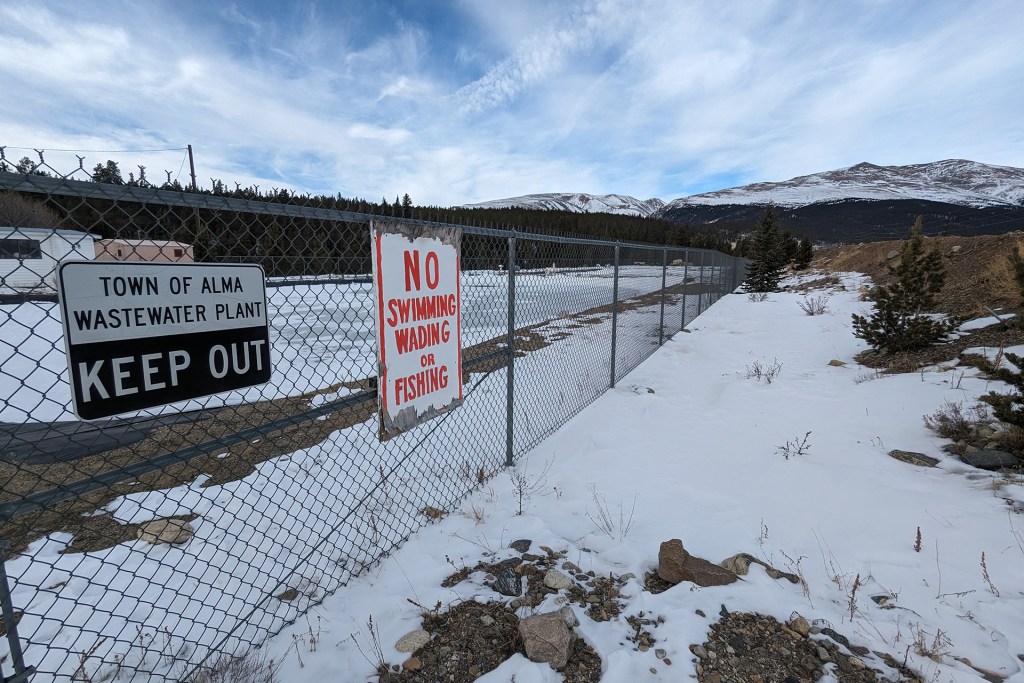
CDPHE issued recommendations to both towns to upgrade their lagoon systems to mechanical treatment plant systems to address discharge issues.
Alma has chipped away at a rehaul of its wastewater system over the last five years, utilizing a variety of state grants to fund the design and planning process. The town acquired a contractor through a construction manager at risk delivery method, which is commonly required to access state funding, and recently completed construction plans.
After learning that a mechanical plant would cost Creede around $14 million, the town engaged a consultant to look at other options to retrofit the current lagoon system. “There are no grants out there that large and Creede doesn’t generate enough revenue from its system to pay for the cost of a mechanical plant,” town manager Louis Fineberg said.
Instead, Creede settled upon an electrocoagulation upgrade to the current system that would help separate heavy metals from the water. Fineberg said the renovation is estimated to cost $3 to $5 million, a fraction of the mechanical plant estimate. The town is waiting for CDPHE approval before attempting to find funding.
Alma is ready to move forward with construction of an $8 to $9 million mechanical plant but is facing funding challenges. Initially, the town was planning on using State Revolving Funding (SRF) to access a CDPHE loan. However, after SRF funding dried up this summer, Alma was no longer able to access the state financing.

“We have had to completely shift gears,” Alma’s town administrator, Gary Goettelman, explained. “We were planning on breaking ground this spring and that will not happen now.”
Alma is now looking into a U.S. Department of Agriculture loan, which requires a different bidding process for contractors, pushing construction to at least 2025.
“We are stewards for the entire watershed,” Goettelman said of Alma’s key placement at the headwaters of the Middle Fork of the South Platte River. “It’s been a long road.”
Alma and Creede will continue to work towards CDPHE compliance in the coming months, pulling on a diverse array of technologies and funding sources to meet state discharge requirements.

“We all share the same problem,” Fineberg said. “It’s harder to make upgrades in small towns with less users on the system because costs are spread out over a smaller number of people. We simply can’t generate enough revenue.”